
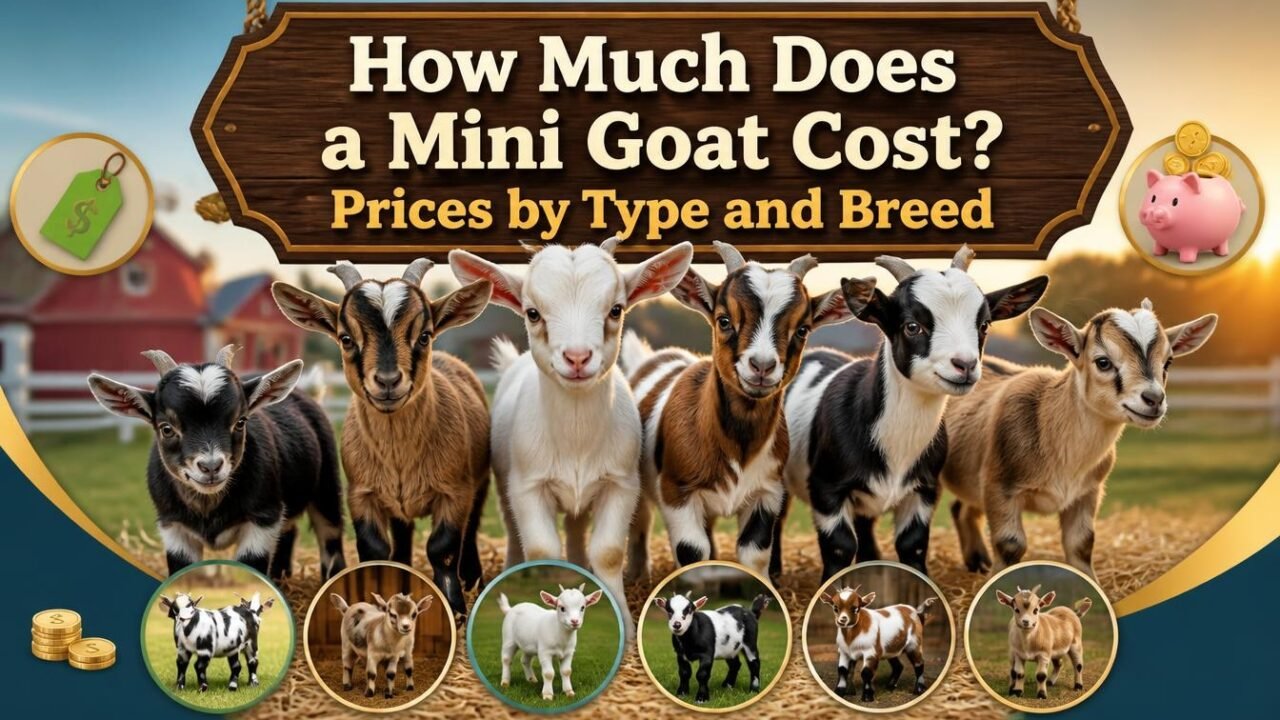
Ask five goat owners how much a mini goat costs and you’ll get five different answers. That’s because the price depends on what kind of goat you’re buying. A calm pet weather and a registered, show-quality doe can look alike across the fence, but they are very different purchases.
If you’re asking how much does a mini goat cost, here’s the short version: at Hoof Miniatures, our mini goats run from $150 to $450 depending on type. This guide breaks down what each type costs, what the wider U.S. market charges, and the extras (delivery, vet paperwork, fencing, feed) that most people only discover after they’ve bought.
Key takeaways
- At Hoof Miniatures, mini goats range from $150 (wethers) to $450 (registered, show quality).
- Across the U.S., pet-quality mini goats commonly sell for roughly $75 to $400, while registered breeding stock can pass $1,000.
- Goats are herd animals, so plan to buy at least two.
- Delivery, vet paperwork and setup come on top of the purchase price, so budget for them from day one.
- Ongoing care is often estimated at $40 to $100 per goat per month.
How much does a mini goat cost?
At Hoof Miniatures, a mini goat costs between $150 and $450 depending on type. Wethers start at $150, doelings are $300, and registered show-quality goats are $450. Across the U.S., pet-quality mini goats often cost roughly $75 to $400, while registered breeding stock can run well over $1,000.
Mini goat prices at Hoof Miniatures, by type
Here is how our current listings break down. Prices are as of October 2026, and availability changes weekly, so check our available animals for what is ready to go home right now.
| Type | What you get | Our price |
| Wethers (neutered males) | Calm, easygoing pets and companions, with no breeding behavior | $150 |
| Bucklings / bucks | Young or intact males for breeding programs | $200 |
| Doelings (young females) | Young does you can raise toward milking or breeding | $300 |
| Does in milk | Mature females already producing milk | $400 |
| Bonded pairs | Two goats raised together, so they arrive with a friend | $300 [confirm: per pair or per goat] |
| Registered / show quality (ADGA/AGS) | Goats with registration papers and pedigree | $450 |
A simple way to read that table: if you want a pet or a companion for another animal, the weather is the budget-friendly choice. If you want milk, you are paying either for a doe that is already in milk or for the time it takes a doeling to grow up. And if you plan to breed or show, registration is where the price climbs.
One practical note on bucks. Intact males need to live apart from the does, and they get strong-smelling in breeding season. For most backyard homes, the weather is the easier animal to live with.
What affects the price of a mini goat?
Six things set the price of a mini goat: the type (wether, doeling, buck or doe in milk), registration and pedigree, age, breed, the health care the breeder has already paid for, and how far the goat has to travel. A registered doeling from strong milking lines costs more than a pet wether of the same age.
- Type and sex. Wethers are usually the lowest priced. Does milk and breeding stock cost more?
- Registration and pedigree. Papers from a registry such as ADGA or the American Goat Society prove parentage and open the door to showing and registered breeding. That paperwork is part of what you pay for.
- Age. Very young kids can cost less than proven adults, but they need more care and take longer to reach breeding or milking age.
- Breed. Nigerian Dwarfs, Pygmies and Mini Nubians are priced differently, as the next section explains.
- Health care. A vet check, vaccinations and deworming cost the breeder real money, and a good price reflects that.
- Location and delivery. The farther the goat travels, the more the total goes up.
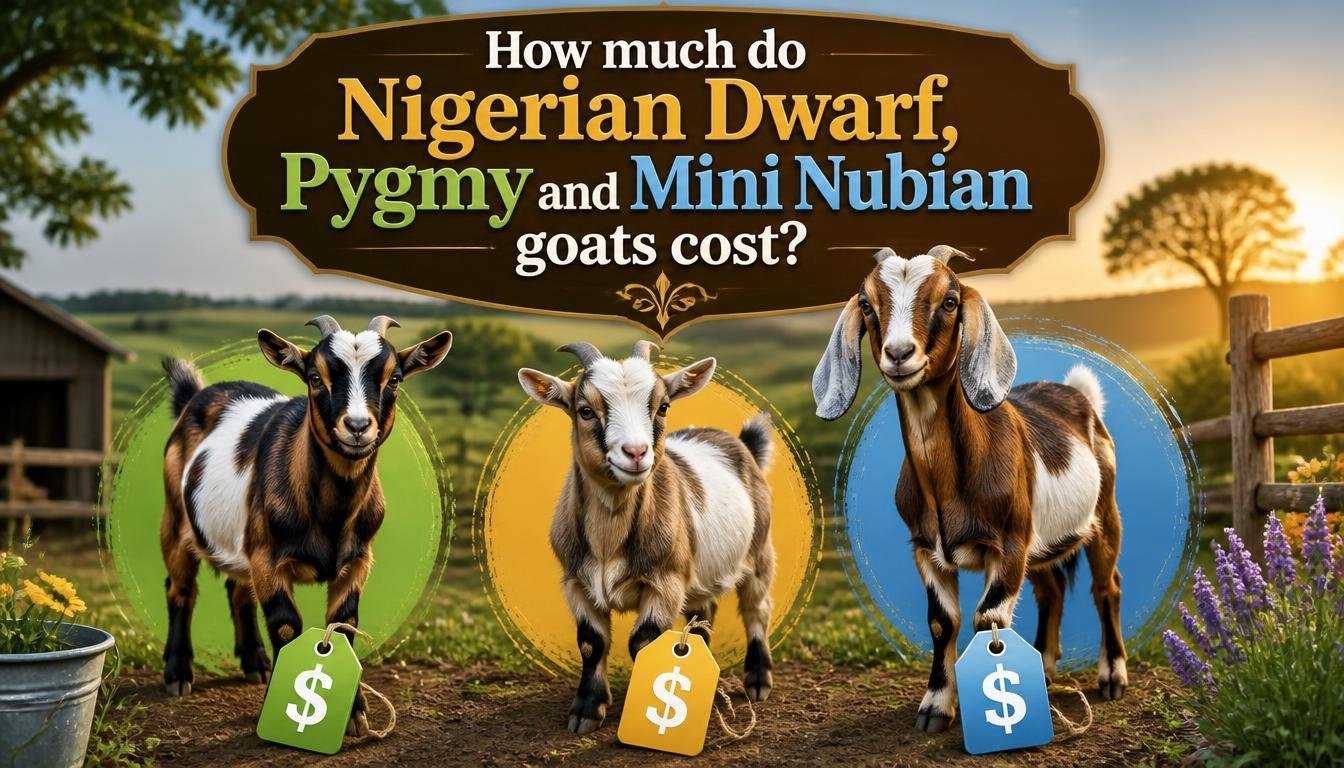
Pygmy goats from reputable breeders often cost up to about $400, according to one breeder guide. Nigerian Dwarfs vary widely: pet-quality goats are around $300, while registered breeding-quality does and bucks are reported at roughly $500 to $1,200. Mini Nubians vary by bloodline, so ask the breeder directly.
Nigerian Dwarf. This is the most popular mini dairy goat, and the price swings the most. A pet-quality goat sits near the bottom of the range. A registered doe from good milking lines sits near the top.
Pygmy. Round, sturdy and playful, Pygmies are usually the more affordable choice when you want a companion rather than a milker.
Mini Nubian. Known for long ears, a gentle nature and creamy milk, Mini Nubians tend to be priced by bloodline and registration.
A word of caution about price guides online. Many are undated and written for different regions, so treat the ranges above as a sanity check, not a quote. The best number is always the one a breeder gives you in writing for a specific animal.
How much does it cost to ship a mini goat?
Shipping depends on distance. One cost guide puts local goat transport at about $50 to $150 per goat and long-distance commercial shipping at $300 or more per goat. At Hoof Miniatures, delivery is quoted per trip based on distance, and you get an exact figure within 24 hours of requesting a quote.
Paperwork is another piece. Goats that cross state lines generally need an Interstate Certificate of Veterinary Inspection from an accredited vet, plus official identification such as a scrapie tag or an RFID ear tag. Some animals, such as young wethers, may be exempt from the federal ID rules, but individual states can add their own requirements. USDA APHIS publishes a goat identification flyer, and your state veterinarian’s office can confirm what your destination requires.
At Hoof Miniatures, we handle the health certificate and transport paperwork before your goats travel, and you can read how that works on our shipping page.
[Add a short real delivery story, such as a pair of goats that traveled to a far-away state and how they settled in.]
What does it cost to keep a mini goat?
One goat cost guide estimates $40 to $100 per month per goat for feed and routine care. Your real number depends on local hay prices, how much pasture you have and your vet. Fencing and shelter are one-time costs that vary the most, so get local quotes before you buy.
Here is a simple first-year budget worksheet you can fill in before you commit:
| Cost | One-time or ongoing | How to estimate it |
| The goats | One-time | Add up the price of each goat (plan on at least two) |
| Delivery | One-time | Request a delivery quote |
| Fencing | One-time | Get local quotes, because goats test every fence |
| Shelter | One-time | A dry spot out of wind and rain |
| Hay, minerals and feed | Monthly | Covered by the $40 to $100 per goat estimate |
| Vet care and vaccines | Yearly | Ask a goat-experienced local vet for rates |
| Hoof trimming | Regular | Learn to do it yourself or hire a trimmer |
Here is a quick example. Say you bring home two wethers at $150 each. Using that $40 to $100 estimate, care for two goats comes to about $80 to $200 a month, or roughly $960 to $2,400 a year, before fencing, shelter and delivery. That’s why we always tell new owners to budget for the whole first year, not just the purchase price.
Why should you buy at least two mini goats?
Goats are herd animals and get stressed and noisy when kept alone. A single goat is rarely a bargain, because it usually ends up needing a companion anyway. Buying two from the start, or a bonded pair raised together, costs more upfront but spares you the harder job of introducing strangers later.
For many families, two wethers is the most affordable way to start. They are calm, they keep each other company, and they have none of the breeding-season behavior that comes with intact males. If you want milk later, you can add a doe once your fencing and routine are working.
How can you tell if a mini goat price is fair?
A fair price matches what the seller includes. Look for a health certificate, current vaccinations and deworming, registration papers where promised, and a written health guarantee. A price far below the going rate, or a seller who avoids video calls and vet records, is a warning sign, not a bargain.
Before you pay anyone, ask these questions:
- Is the goat registered, and can I see the paperwork?
- What vet care, vaccines and deworming has it had?
- Is there a written health guarantee?
- Who arranges the health certificate and delivery?
- Will you answer questions after the goat arrives?
At Hoof Miniatures, every animal comes with a veterinary health check and certificate, up-to-date vaccinations and deworming, registration paperwork where applicable, a personalized care guide and lifetime phone and email support. That is the standard we’d suggest you hold any seller to.
When is a local breeder the better choice?
If you live near a good breeder and can drive to pick up your goats, local often wins. You skip shipping, and you can meet the animals in person. Shipping makes more sense when you want a specific type or bloodline, when nobody nearby has what you need, or when you want the paperwork and transport handled for you. Either way, ask the same questions and get the answers in writing.
Frequently asked questions
How much is a mini goat?
At Hoof Miniatures, mini goats cost $150 to $450 depending on type. Across the U.S., pet-quality mini goats often sell for roughly $75 to $400, and registered breeding stock can cost $1,000 or more. Delivery and setup are extra.
What is the cheapest type of mini goat?
Wethers (neutered males) are usually the least expensive. At Hoof Miniatures they start at $150. Pet wethers also make easygoing companions, which is why they are a popular first purchase, ideally in pairs.
Why do registered mini goats cost more?
Registration documents the goat’s parentage and lets you register offspring and compete in shows. The breeder has also usually invested more in selecting breeding stock. At Hoof Miniatures, registered, show-quality goats are $450.
How much does it cost per month to keep a mini goat?
One cost guide estimates $40 to $100 per goat per month for feed and routine care. Your own cost depends on hay prices, pasture and vet rates in your area, so price local hay before you buy.
Do mini goats need paperwork to travel across state lines?
Generally yes. Goats moving between states usually need a Certificate of Veterinary Inspection and official identification, and some states add their own rules. Check your destination state’s requirements, or ask your breeder to handle it, as we do.
Is it cheaper to buy two mini goats together?
Two goats cost more than one, but buying a bonded pair raised together can be the smoother and often cheaper route in the long run. Goats are herd animals, so a single goat tends to need a companion sooner or later.
Next step: find your mini goats
Ready to see what’s available? Browse our mini goats or see how the process works on our how it works page. If you’d like an exact delivery figure, request a quote and we’ll reply within 24 hours.
2 comments